The guys (Kareem, Ken, and Pat) continue their review about what money means in comics. Tangents include Tony Stark wearing Walmart sweatpants, Like Cage the loan officer, magic money vs. science, and more.
Show Notes
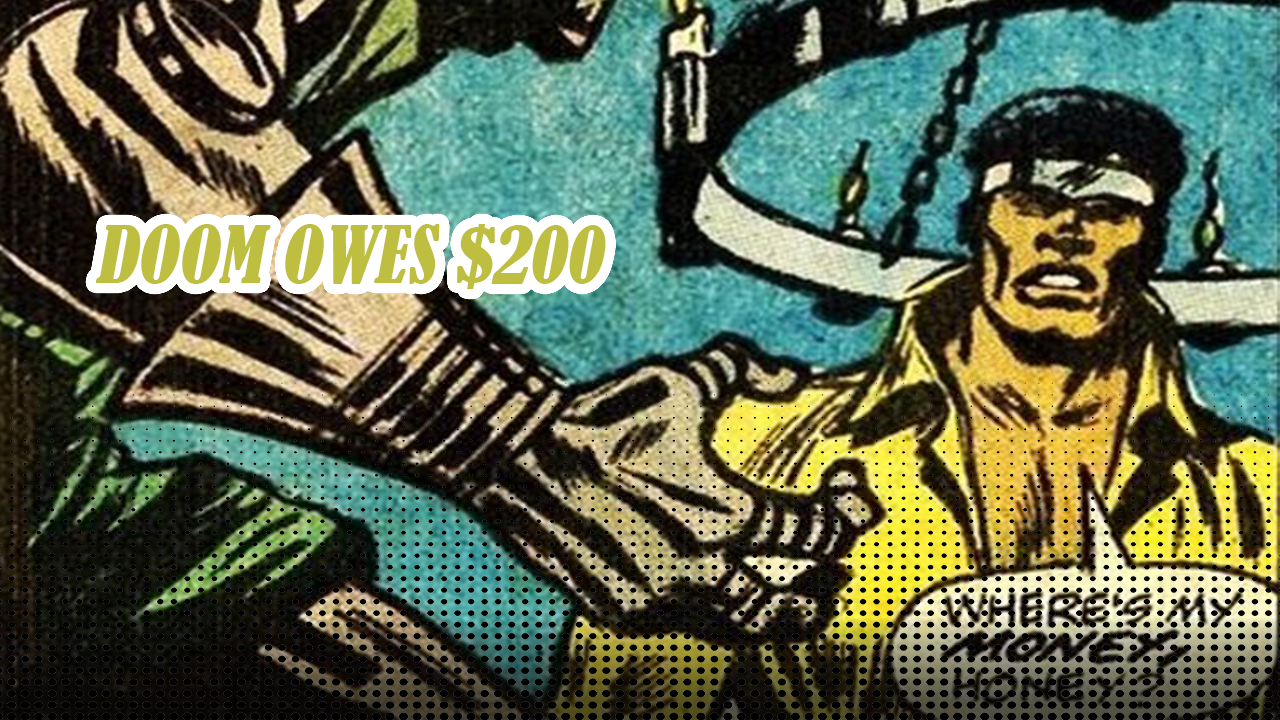
We kick things off with the infamous “Doom owes money” storyline, where Luke Cage literally has to chase down Doctor Doom for unpaid wages. It’s a perfect entry point into the strange economics of comic book billionaires. Doom’s mystical Latverian wealth, built on sorcery and sovereignty, stands in sharp contrast to Tony Stark’s corporate empire, which is rooted in technology and capitalism. Both characters highlight how comic book billionaires bend the rules of accountability—whether through magic loopholes or corporate ones.
But before we get too deep into fictional finance, let’s pause and ask: what does a billion really mean? A billion is one thousand million. Put another way, if you spent $10,000 every single day, it would take you 274 years to burn through a billion dollars. Most people don’t live past 90, so the scale of wealth here is almost incomprehensible.
That scale becomes even clearer when we look at history. John D. Rockefeller became the world’s first confirmed billionaire in 1916, thanks to his oil empire. Even today, when adjusted for inflation, Rockefeller rivals modern titans like Gates, Bezos, and Musk. Reports like Oxfam’s 2017 study underline the imbalance, noting that just eight billionaires hold as much wealth as half the human race. Of course, those numbers spark debate, especially since debt is counted as negative wealth, skewing the picture of who is “poor” or “rich.”
The billionaire class has also diversified. In the past five years, the number of female billionaires has grown by nearly 50%, outpacing male growth rates. Today, there are over 430 women billionaires worldwide, a sharp rise from 160 in 2013 (NBC News).
Globally, the billionaire boom really took off in the 1970s, with American oil magnates, Middle Eastern tycoons, and European industrialists joining the ranks. By the 1980s, Japan’s asset bubble produced billionaires like Yoshiaki Tsutsumi, once worth $20 billion (Japanese asset bubble overview). At one point, Japanese billionaires dominated the global top ten, while U.S. billionaires barely made the list. The roster even included figures like Sweden’s Rausing brothers, Canada’s Reichmanns, and yes—Colombian drug lord Pablo Escobar.
When you put it all together, the parallels between comics and reality are striking. Fictional billionaires dodge accountability with magic or tech, while real billionaires do it with loopholes and monopolies. Both worlds remind us that wealth isn’t just about money—it’s about bending the rules, shaping culture, and deciding who gets paid… or who doesn’t.

EP.120 – Jimmy Olsen's Manosphere Problem – A Review of James Gunn's Superman pt.4 – Tangential Giants Podcast
- EP.120 – Jimmy Olsen's Manosphere Problem – A Review of James Gunn's Superman pt.4
- Shawarma vs Falafel vs Vaccines – A Review of James Gunn's Superman pt.2
- Super Woke or Super Broke – A Review of James Gunn's Superman pt.1
- EP.116 – When Winking Makes you Blind – Brainstorming Ideas for Comic-Con pt.2
- CAPES, CHOAS, AND COLLECTIBLES – Reviwing content for our 2025 Comic-Con panel




















 tangentialgiants.com